How Much Does a Macy's Parade Balloon Cost in 2026?
A brand-new balloon in the Macy's Thanksgiving Day Parade costs its sponsor about $200,000 in the debut year, and roughly $90,000 to bring back each year after that. Both numbers are sponsorship fees reported by outlets such as CBS and Good Housekeeping, and they bundle design, construction, helium, crew and parade operations into one line — Macy's does not sell its balloons. We build giant helium inflatables for brand events and city parades, so this article breaks the number down from the production side: what the fee actually covers, which engineering variables drive the cost of a parade-scale balloon, and what a project like this looks like when the client is a city festival or a brand instead of Macy's.
How Much Does a Macy's Parade Balloon Cost?
A new Macy's parade balloon costs approximately $200,000 in its first year. A returning balloon costs around $90,000 per appearance. The fee is paid by the company behind the character and covers design, construction, inflation, the handling crew and parade-day operations. Fewer than ten new balloons debut in most years.
The two-tier structure maps directly onto the production reality. Year one carries the design and build: concept work, scale models, patterning, fabrication and test flights. The returning-year fee covers storage, inspection and refurbishment, a fresh helium fill, and the crew and logistics of parade morning. For comparison, the parade's floats — the wheeled stages that roll rather than fly — run $30,000 to $100,000 to build. Balloons sit above that range because a flight-rated helium envelope, its net and rigging, and the safety operation around it are a different engineering class from a rolling stage.
Why do brands pay it? Because the audience justifies it. The 2024 parade drew 25.4 million television viewers, and the 2026 edition on November 26 is the 100th parade in the event's history — the largest single-day live audience a character balloon can reach anywhere.
What Does the Macy's Fee Actually Cover?
The fee buys an operations program, and the physical balloon is only one part of it. Four budget lines sit inside that number:
Design and construction. Every balloon is designed and built at Macy's Parade Studio, the event's own workshop in Moonachie, New Jersey. A new balloon starts as sketches and a scale model, then moves to full-size patterns, fabric panels, painting and test flights before it is approved for the route.
Helium. The parade's balloons collectively consume 300,000 to 700,000 cubic feet of helium, and reported helium spending for a single parade has passed $510,000. The gas arrives by tanker truck and goes in the day before the parade, at the public inflation event beside the American Museum of Natural History — an operation that draws its own crowd of spectators every year.
People. Each giant balloon flies under a pilot and a captain with 50 to 90 trained handlers on the tether lines. Handlers train in advance, and the crew cost repeats every year the balloon flies.
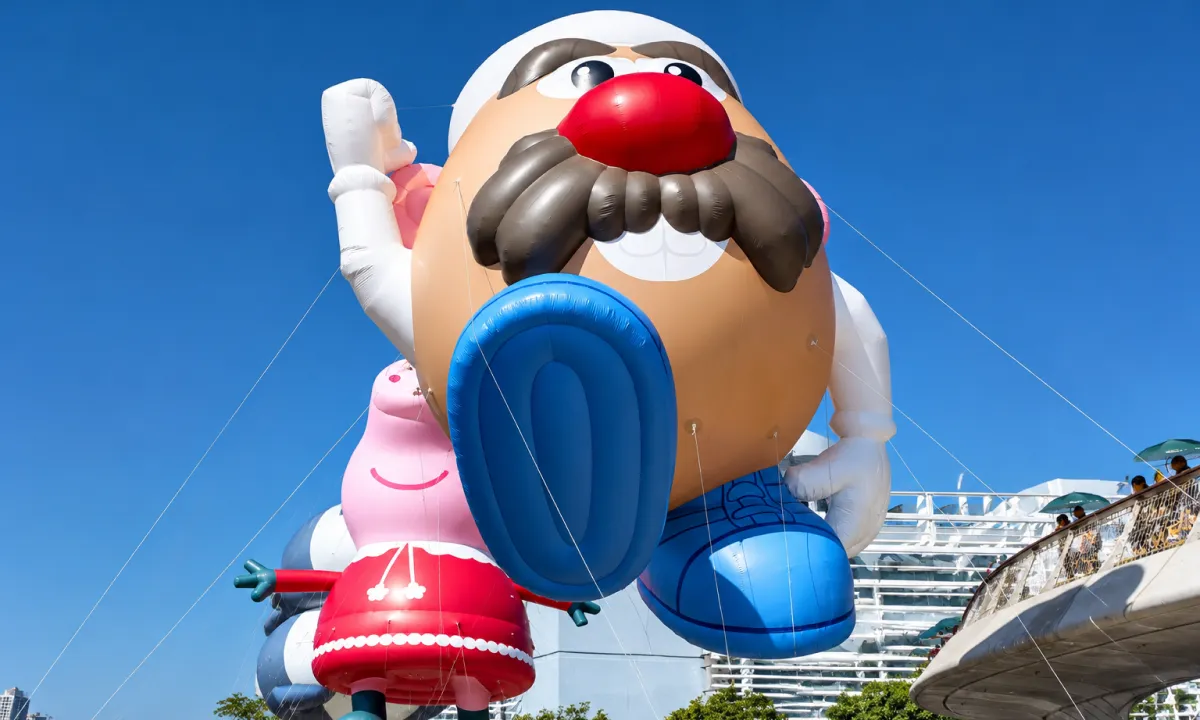
Safety and compliance. After a 1997 accident involving the Cat in the Hat balloon, New York City tightened the rules: balloons are grounded when wind gusts pass 34 mph, each balloon carries an anemometer, and flight altitudes are managed along the route. Even the floats are engineered around logistics — they fold to no more than 8.5 feet wide to pass through the Lincoln Tunnel from the New Jersey warehouse.
The Real Cost Drivers, From a Manufacturer's Bench
The sponsorship fee is a media number. From a production floor, the build cost of any giant helium balloon — Macy's-scale or city-scale — comes down to five variables:
| Cost driver | What it affects | How it scales |
|---|---|---|
| Envelope volume | Helium demand, fabric consumption, pattern count | With the cube of dimensions — twice the size means roughly eight times the gas and material volume |
| Gas-tight material | Helium retention, refill frequency, service life | PU holds helium 3–5x longer than nylon-coated fabric |
| Artwork and surface | Printing or painting hours, color proofing | With coverage area and detail level |
| Sewing and reinforcement | Skilled labor hours | With panel count, curves and stress points |
| Testing and rigging | Inflation-test hours, tether hardware | With size and site wind exposure |
Material choice is the driver most buyers underestimate. Our own builds use 0.18 mm PU with high-frequency welded seams, and the retention gap is decisive: PU holds helium three to five times longer than nylon-coated fabric, so a single fill keeps a PU envelope flying for five to ten days where nylon-coated material typically needs a refill every one to three days. At parade scale, every refill means thousands of cubic feet of helium plus the crew to handle it. Retention is an operating-cost decision, not just a material spec.
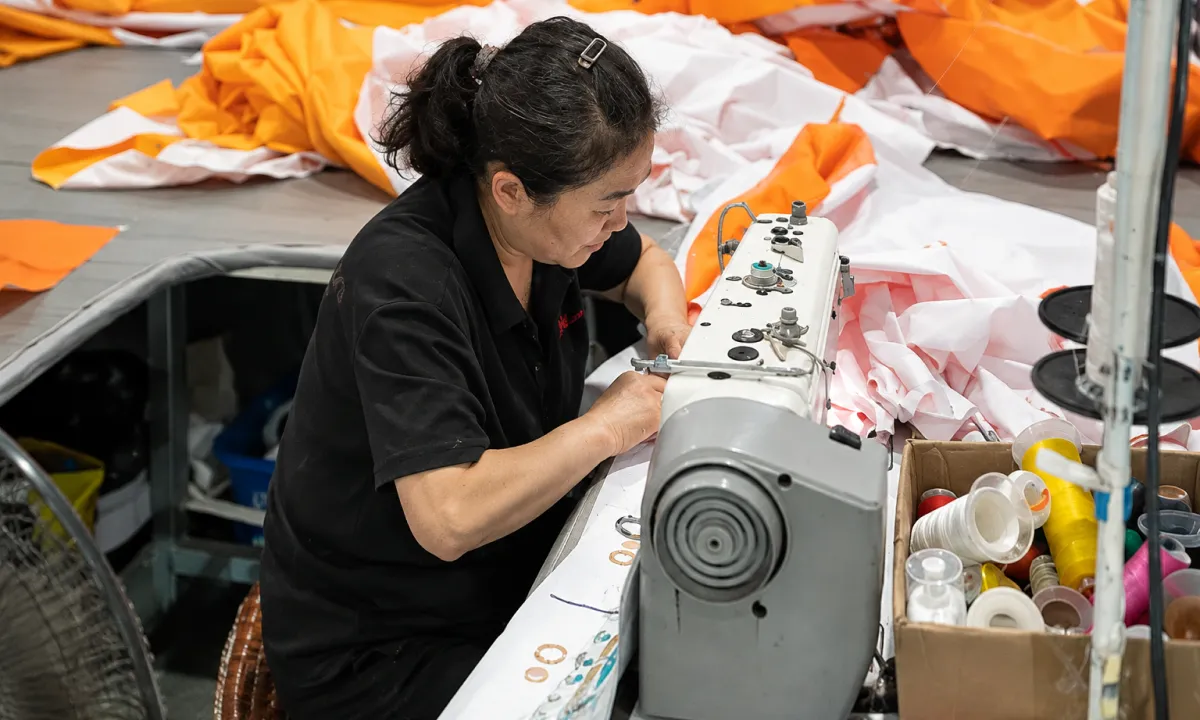
Sewing is the largest labor block. Complex character shapes multiply the panel count, and every panel is cut, printed, stitched and inspected. On our floor, more than 50 skilled sewing workers handle production, every seam is double-stitched, and stress points get reinforced bar tacking. Artwork sits on top of that labor: a photorealistic character face can need full-coverage printing plus hand-finished detail, with color proofs approved before the first panel is cut.
Testing closes the loop. Nothing leaves a serious factory without a full inflation test — ours runs 24 hours per piece, checking air retention, seam integrity, structural balance and color consistency. A parade balloon that fails its test costs far less than one that fails on a broadcast route.
Why Bigger Balloons Cost Exponentially More
Helium provides roughly one kilogram of lift per cubic meter. Everything the balloon carries — envelope, net, rigging and tether hardware — must fit inside that lift budget, and the budget follows the cube law: doubling a balloon's dimensions multiplies its volume by about eight, while its surface area quadruples. An illustrative example: a spherical envelope 10 meters across holds about 523 cubic meters and generates roughly 520 kg of gross lift. At 20 meters, the same shape holds around 4,200 cubic meters with over four metric tons of lift — and eight times the helium bill.
Scale jumps move everything else up a bracket with them. Fabric and print area grow with the square of the size, wind load grows with the same area, and transport, test space, crew count and insurance all step up by class. Macy's largest balloons stand five to six stories tall. In commercial work, custom helium inflatables typically run from 2 to 24 meters — already large enough that a one-class jump in size can move the project into different handling equipment and a different test hall.
The full production sequence behind these numbers — 3D modeling, patterning, printing, welding and inflation testing — is covered step by step in our article on how giant inflatables are made.
What If You're Not Macy's?
City holiday parades, brand activations and festival openers commission parade-grade helium balloons from custom manufacturers every year, and this is a standard, quotable project type. A quote depends on a short list of variables: envelope size, shape complexity, artwork coverage, the retention requirement (a single-day flight or a multi-day installation), tether and wind requirements at the venue, and the timeline. Production itself typically runs 20 to 45 days depending on complexity, after the design is approved — for a late-November event, that means starting the conversation in early autumn at the latest.
Manufacturers do not publish flat prices for this work because the five cost drivers above move the number by orders of magnitude between projects; our own breakdown of what drives custom giant inflatable pricing covers the same logic for cold-air pieces. What speeds up any quote is a complete brief: character or design references, target size, event date, the venue and its wind exposure, and how long the balloon needs to stay aloft.
The 100th Macy's parade will put helium balloons in front of their largest audience yet this November. If that audience — or your own city's version of it — is on your roadmap, our team builds custom helium inflatables from 2 to 24 meters and can turn a complete brief into a proposal with pricing within one to two working days.
FAQ
A new balloon costs its sponsor about $200,000 in the debut year and around $90,000 to return in following years. The figure is a sponsorship fee covering design, construction, helium, crew and parade operations — Macy's does not sell the balloons themselves.